
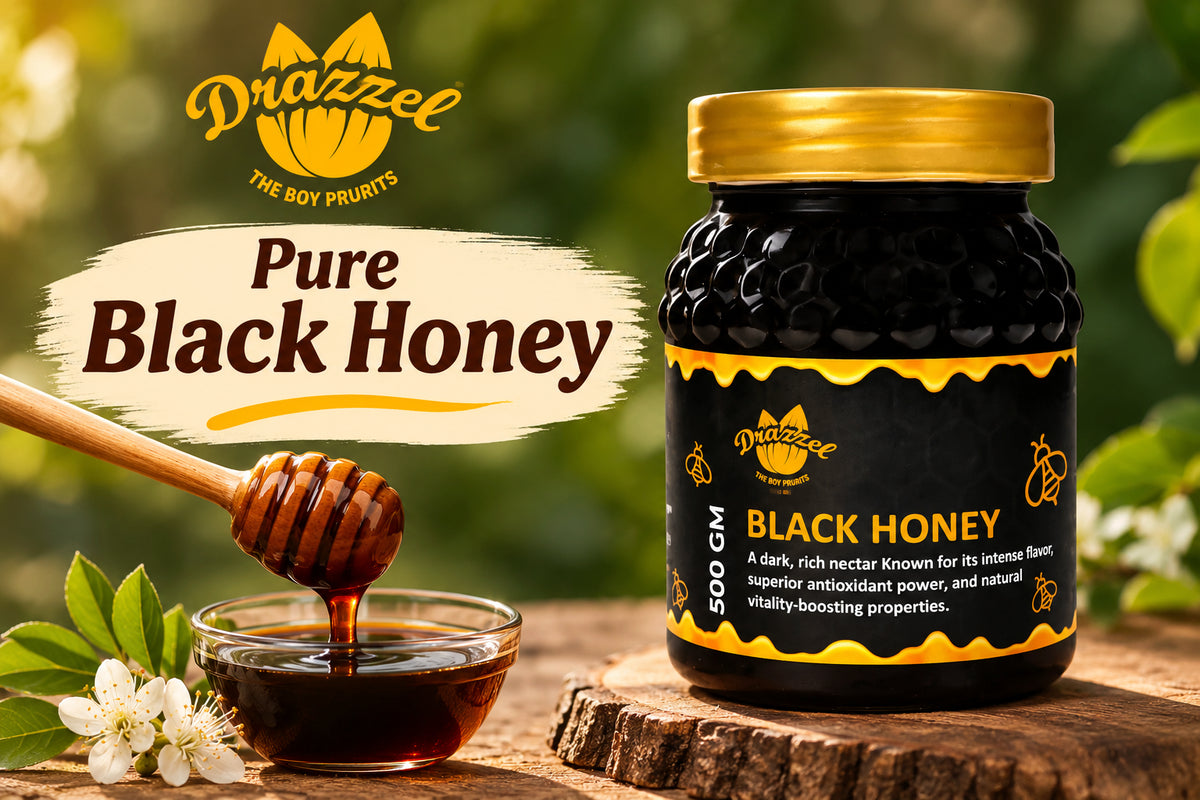
A dark jar on a shelf doesn't mean much. Anyone can add colour, caramel or molasses to cheap honey and call it black honey, and a lot of buyers only find out after the first spoonful tastes like burnt sugar. If you want pure black honey, you need to know what to look for before the money leaves your account. This guide covers the checks that actually help and the popular tricks that don't.
Why Black Honey Gets Faked So Often
Black honey costs more than regular honey. It comes from specific forest regions, the harvest is smaller, and it's usually handled with less processing. That price gap is exactly why it attracts shortcuts.
The usual fakes fall into three groups. Some sellers dilute real honey with sugar syrup. Some darken ordinary honey with caramel colour or jaggery syrup. And some simply label a standard dark honey as "black honey" without any sourcing behind the claim. Knowing these three tricks makes it easier to spot what's wrong when something feels off.
Start With the Label
The label tells you more than the colour ever will. Before anything else, read the whole thing, front and back.
Look for the ingredient list first. Pure black honey should list one thing: honey. If you see sugar, glucose, invert syrup, caramel or "flavouring," put the jar down. Next, check for a valid FSSAI licence number. It should be printed clearly, not hidden in tiny text. Then look at the batch number, packing date and expiry date, since a brand that tracks batches is a brand that can be held accountable.
The sourcing line matters too. Genuine black honey usually mentions where it was collected, such as a forest region or a floral source. A label that only says "natural black honey" with no origin is vague on purpose.
Colour and Texture
Real black honey isn't pitch black. Hold the jar up to natural light and you'll usually see a deep brown or dark amber, almost like strong tea or molasses, with reddish tones at the edges. It's thick, but it still moves slowly when you tilt the jar.
If the honey looks completely black and opaque, even under bright light, be careful. That often points to added colour. If it looks watery and runs fast like syrup, it may have been thinned out. Pure black honey sits somewhere in between: dense, glossy and a little sticky when you rub it between your fingers.
Smell and Taste
Your nose and tongue will tell you a lot, as long as you know what you're checking for.
Pure black honey has a rich, earthy smell with a slightly woody or floral edge. There's sweetness, but it isn't sharp. When you taste it, the flavour is bolder than regular honey. You might notice caramel-like notes, a mild bitterness and a long aftertaste that sticks around for a while.
Fake or adulterated honey tends to go wrong in predictable ways. A burnt sugar smell usually means caramel colour. A flat, one-note sweetness with no depth often means sugar syrup. And a sour or fermented smell points to poor storage or too much moisture. If the first spoonful tastes like plain sugar water with a dark tint, trust that reaction.
Does Pure Black Honey Crystallise?
Yes, and that surprises a lot of people. Honey that hasn't been heavily processed will often crystallise over time, especially in cooler weather. You may see fine sugar granules at the bottom of the jar or a thicker, creamier texture after a few weeks.
This isn't a sign of fake honey. In many cases it's a sign of the opposite. Heavily filtered and heated honey stays liquid for months because the crystal-forming particles have been removed. If your jar of pure black honey has gone grainy, sit it in a bowl of warm water for 15 to 20 minutes and it will loosen up again. Don't microwave it, since high heat damages the honey's natural qualities.
Pay Attention to Price
Price won't prove anything on its own, but it can raise a flag. Black honey sourced from forest regions and handled in small batches costs more to produce. If you see a large jar at a price lower than ordinary supermarket honey, ask yourself how that's possible.
Compare the cost per 100 grams across a few brands rather than looking at the jar price. A very cheap rate usually means one of two things: the honey has been diluted, or it isn't black honey at all. A fair price won't guarantee quality, but a suspiciously low one is a reason to walk away.
The Home Tests: What They Can and Can't Tell You
You've probably seen the popular kitchen tests. The thumb test says real honey stays in a thick drop on your thumb. The water test says pure honey sinks to the bottom of a glass instead of dissolving right away. The flame test says honey on a cotton wick will burn if it's pure.
Here's the honest picture. These are folk methods, not lab science. Thick sugar syrup can pass the thumb and water tests, and honey with slightly higher moisture can fail the flame test even when it's genuine. Treat a pass as a rough first look, never as proof.
What these tests can do is catch obvious problems: a runny, watery texture, or a product that dissolves instantly into water. For anything beyond that, you need better evidence.
Look for Lab Testing and Transparency
The most reliable check isn't something you do at home. It's a lab report. Serious honey brands test their batches for adulteration, moisture content and added sugars, and some publish the results or share them when asked.
Ask the seller whether they can provide a recent lab report for the batch you're buying. A brand confident in its pure black honey won't mind the question. If a seller avoids it, changes the subject or sends a vague reply, you've learned something useful without spending a rupee.
Also check how open the brand is in general. Does the website say where the honey comes from, and is there a working contact number and return policy?
Check the Packaging
A glass jar with a tamper-evident seal is a good sign. Food-grade plastic is fine too, as long as the seal is intact. When your order arrives, take a photo of the unopened jar so you have proof ready if something is wrong.
A Short Checklist Before You Order
When you're ready to buy, run through these points once:
-
The ingredient list says honey and nothing else
-
A valid FSSAI number is printed on the pack
-
Batch number, packing date and expiry date are visible
-
The label names the source region or floral source
-
The price per 100 grams isn't far below other black honey brands
-
The seller can share lab testing details
-
Reviews from verified buyers mention taste and texture, not just delivery speed
If most of these check out, you're in good shape. If several are missing, move on.
How to Store Pure Black Honey at Home
Keep it in a cool, dry place away from sunlight and the stove. Use a clean, dry spoon every time, since even a few drops of water can push honey toward fermentation, and close the lid tightly after each use.
Buying With Confidence
Spotting pure black honey comes down to a handful of habits: read the label, check where it comes from, trust your senses, treat price as a clue and ask for proof when you're unsure. None of it takes long.
Ready to taste the real thing? Shop Drazzel Black Honey today and bring home honey you can trust.
Frequently Asked Questions
How can I tell if black honey is pure?
Check the ingredient list for honey only, look for a valid FSSAI number and batch details, and ask the seller for lab testing. Colour, smell and taste give extra clues, but a lab report is the most reliable proof.
Is pure black honey really black?
Not quite. It usually looks deep brown or dark amber, sometimes with reddish edges in natural light. A jar that looks completely black and opaque may contain added colour.
Does pure black honey crystallise?
It can, especially in cool weather. Crystallisation is a normal sign of minimally processed honey. Warm the jar gently in a bowl of warm water to bring back a smoother texture.
Do the water and flame tests prove honey is pure?
No. These are folk tests and can give wrong results either way. They can catch obvious problems, but they can't confirm purity the way a lab test can.
Why is pure black honey more expensive than regular honey?
It comes from specific forest regions, is harvested in smaller quantities and is usually processed less, all of which raise the cost of producing it.